
How to solve a crossword
Start with a clue you know. Use its letters to solve an intersecting word. Try it with the two clues below.
Try two crossing clues
These two answers start in the same square, so they share their first letter.
5 Down · three letters
Chocolate ___
Check 5 Down
BAR completes “chocolate bar.” Put the B in the shared square to start 5 Across.
5 Across · five letters
Media ___ (powerful owner)
Check 5 Across
BARON fits five squares, starts with B and means someone powerful in the media business.
For the rest of this practice grid, open sample mini #1.
How the grid works
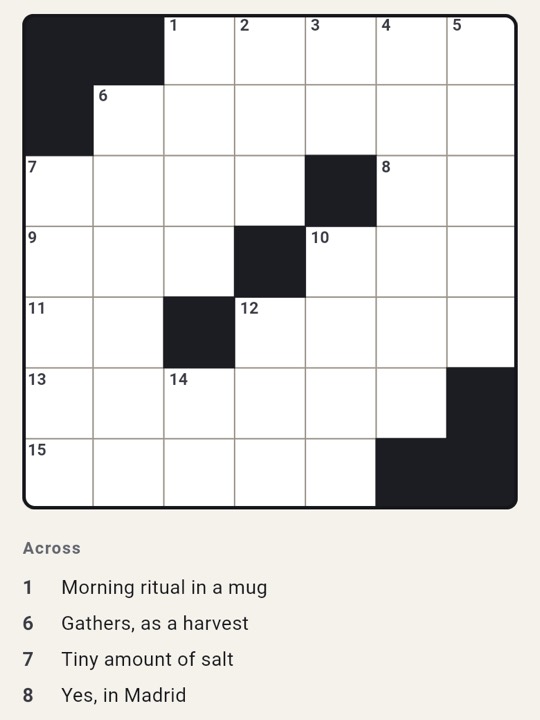
A crossword is a grid of white and black squares. Each white square holds one letter. Runs of white squares read Across (left to right) or Down (top to bottom), and each run, called an entry, has a numbered clue. Most squares belong to one Across answer and one Down answer at the same time, and that overlap, the crossing, is what makes a crossword solvable.
Grids come in many sizes. A mini crossword often has a 5×5 or 7×7 grid. A full newspaper grid is often 15×15 or larger. If you are new, start with a mini: fewer clues, shorter answers and a finish line you can see. The crossword terms guide explains the rest of the vocabulary.
Read the clue, not just the words
A clue and its answer can swap places in a sentence. Before you guess, check that your idea could stand in for the clue word for word. Count the squares too: a five-letter answer rules out most of your first ideas.
Plural and tense must match
A plural clue wants a plural answer, and a past-tense clue wants a past-tense answer. “Showed on TV” is past tense, so the answer ends like a past-tense word, such as AIRED. A verb clue wants a verb; an adjective clue wants an adjective.
A question mark changes what you are looking for
A clue that ends in “?” is playing with you. The obvious meaning is usually wrong, so look for a pun, a second sense of a word or a twist on a familiar phrase.
Abbreviations and fill-in-the-blanks
“Abbr.”, “for short” or “briefly” ask for a short form. A clue with “___” asks you to finish a phrase, like “Chocolate ___”. Both are among the easiest clues to crack. Types of crossword clues covers these signals and more.
Where to start
- Fill-in-the-blank clues. Finishing a familiar phrase is easier than recalling a definition.
- Short answers. Three- and four-letter entries have few options and give letters to everything that crosses them.
- Whatever you are sure of. Skip a clue the moment it stalls. You will come back with letters in hand.
New solvers do best with small grids first. Try the free sample mini crosswords, 5×5 grids with every answer explained, then move up to a 7×7. If you like a pen in hand, every past Daily is also a printable crossword.
Work the letters, not the words
When the meaning of a clue won’t come, look at the letters you already have. English words follow patterns, and the pattern often gives the answer away.
- Rare letters narrow things fast. A Q is almost always followed by U. A J, Z, X or K in a crossing leaves very few words that fit.
- Endings repeat. Many answers end in -S, -ED, -ER, -ING or -LY. If the clue is plural or past tense, pencil in the ending before you know the word.
- Vowels and consonants alternate. Three consonants in a row are rare. If a square sits between two consonants, it is probably a vowel.
- Try letters one at a time. With _ R _ S S, run through the vowels: CROSS, DRESS, GRASS, PRESS. Then let the clue choose.
To see every word that fits a pattern, type the letters you know with a ? for each blank into the crossword solver, or browse common 5-letter words and 7-letter words by first letter.
Let crossings do the work
Every answer you place gives letters to the answers that cross it. A clue that meant nothing at first often becomes obvious with two letters filled in. When you are stuck on an Across answer, try the Down clues that cross it, and the other way round.
Crossings also tell you when something is wrong. If two or three Down answers in a row stop making sense, the Across answer they share is probably a mistake. Clear it and try the area again from a crossing you trust.
When you are stuck
- Read the clue another way. “Let go from a job” is not about letting go of a rope.
- Doubt one answer. If the crossings stop making sense, one placed answer is probably wrong. Clear it and try again.
- Look at every clue at once. Seeing Across and Down side by side often shows a crossing you missed.
- Walk away for a minute. A fresh look often finds the answer that a long stare missed.
- Take a hint. In ClueSprint, when Reveal letter is offered it fills one square, and your result shows how many hints you used.
Looking something up isn’t failing; it is how most solvers learn. Checking which words fit your letters in the solver teaches you patterns you will spot on your own next time.
Solve with a friend
Two people rarely get stuck on the same clue. One knows the film, the other knows the river, and each answer gives the other new letters. In ClueSprint you can share one grid with a friend and take turns placing letters: see how to play a crossword puzzle with friends.
Practise a little every day
The fastest way to get better is a small puzzle every day. The same short words come back again and again, and soon you will write them in without thinking. ClueSprint has a free Daily: a new 7×7 grid at midnight UTC on the ClueSprint home page. When you want to get faster, read how to get better at crosswords.
Common questions
How do you solve a crossword puzzle as a beginner?
Start small, with a 5×5 or 7×7 mini. Fill in the blanks and the short answers first, then use the letters they give you to work out the longer ones. Skip any clue that stalls and come back later.
How can I solve crosswords faster?
Practise a little every day and switch direction as soon as a crossing gives you a letter. See how to get better at crosswords for eight tips and a four-week plan.
What are the most common words in crosswords?
Short words full of vowels, like ERA, ORE, AREA, ALOE and OREO, appear often because they fit almost anywhere. Solvers call them crosswordese; once you know them, many grids get easier.
What does a question mark mean in a crossword clue?
It warns you that the clue is playful: a pun, a second meaning or a twist on a common phrase. Read it again and look for a meaning other than the obvious one.
Is it cheating to look up crossword answers?
Not if it helps you learn. Looking up a word, or checking which words fit the letters you have, is how most solvers pick up new vocabulary. Just decide for yourself when a lookup still counts as your solve.