
Types of crossword clues
A clue says more than its words. Every clue follows a convention, and each type tells you the length, tense and tone of the answer. Learn them once and every grid gets easier.

Here are the main types, from the most common to the most playful: straight definitions, abbreviations, wordplay with a question mark, examples, foreign words, fill-in-the-blanks and quotations. If you are new to crosswords, start with how to solve a crossword.
Straight clues: the clue and the answer agree
Most clues are plain definitions, and the most useful rule is that a clue and its answer are the same kind of word. A plural clue wants a plural answer. A clue in the past tense wants a past-tense answer. A clue that is an adjective wants an adjective.
A quick test: imagine swapping the answer into a sentence where the clue would fit. If the sentence still reads naturally, you are on the right track. “Ran quickly” could become SPED or RACED, but never RUN or RUNNING.
Abbreviations: “abbr.”, “for short”, “briefly”
When a clue ends in “abbr.”, “for short”, “briefly” or “in brief”, the answer is a short form too: an abbreviation, an initialism or a clipped word. “Doctor, for short” is DOC; “Physical education, briefly” is PE.
The same goes for a clue that contains an abbreviation itself, such as a title written as “Dr.” or a month written as “Jan.” The shortened clue hints that the answer is shortened as well.
Wordplay: a question mark means a second meaning
A question mark at the end of a clue says “don’t take me literally.” Expect a pun, a playful reading of a common phrase, or a word used in an unusual sense. Read the clue once straight, then once sideways.
A classic example is “Flower in Egypt?”: not a rose or a lily but the NILE, a river that flows. The question mark is the only warning you get, so treat it as a promise that the obvious reading is wrong.
Examples and groups: “for one”, “e.g.”, “say”
When a clue names something and adds “for one”, “e.g.”, “say” or “perhaps”, that thing is an example. The answer is usually the wider group it belongs to: “Oak, for one” is TREE, and “Mars, e.g.” is PLANET. Now and then it runs the other way, with the group in the clue and one member in the grid, so let the letter count decide.
Foreign words: “in Paris”, “in Madrid”
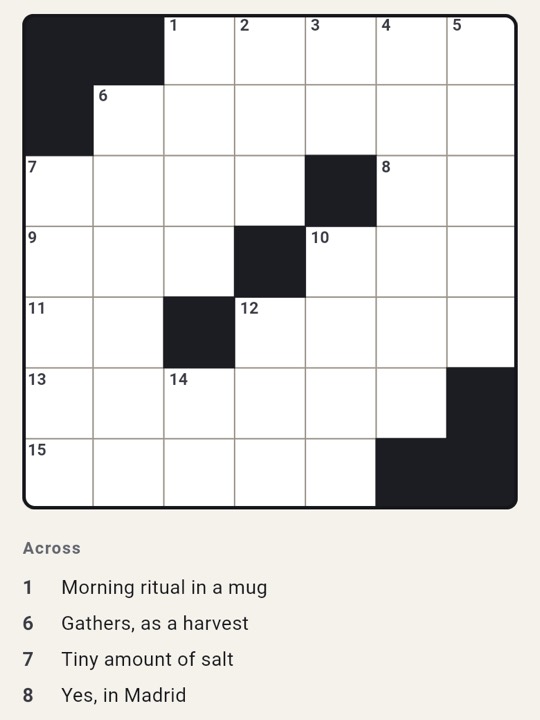
A place name added to a clue, or a phrase like “French word for”, asks for the answer in that language. “Friend, in Paris” is AMI; “Yes, in Madrid” is SI. These answers are usually short, common words a traveler would know, which is why the same handful appear again and again.
Fill in the blank
A clue with a gap, written as “___”, asks you to complete a familiar phrase, title or saying, like “Chocolate ___” for BAR. These are often the easiest clues in the grid, which makes them a good place to start: you only need to recognise the phrase, not recall a definition.
Quotation marks and tone
A clue in quotation marks is something a person might say aloud. The answer is another way of saying the same thing, in the same tone: “I’m stumped!” could be NO IDEA. Words like “informally” or “slangily” ask for a casual word, not a formal one.
What the numbers in brackets mean
In many newspapers, and in almost every cryptic crossword, a clue ends with numbers in brackets, like (5) or (3,5). They give the length of the answer. A single number is one word; numbers separated by commas mean several words, so (3,5) is a three-letter word followed by a five-letter word, such as ICE CREAM. A hyphen, as in (4-2), means a hyphenated answer.
Many American-style puzzles, including ClueSprint, leave the numbers out: the squares in the grid already tell you the length. Count them before you guess.
Clue signals at a glance
| Signal | What it tells you | Example |
|---|---|---|
| abbr., for short | The answer is a short form | Doctor, for short: DOC |
| ? | Wordplay; don’t read it literally | Flower in Egypt?: NILE |
| for one, e.g., say | The clue gives an example | Oak, for one: TREE |
| in Paris, in Madrid | The answer is in that language | Friend, in Paris: AMI |
| ___ | Finish the phrase | Chocolate ___: BAR |
| “Quotation marks” | Something said aloud, same tone | “I’m stumped!”: NO IDEA |
| informally, slangily | A casual word | Friend, informally: PAL |
| (3,5) | Answer length and word breaks | Frozen dessert (3,5): ICE CREAM |
Common questions
What are the different types of crossword clues?
Most clues are straight definitions. The rest signal a twist: abbreviations, wordplay marked by a question mark, examples marked “for one” or “e.g.”, foreign words, fill-in-the-blanks and clues in quotation marks. Each type is explained above with an example.
What does “for one” mean in a crossword clue?
It marks an example. “Oak, for one” names one tree, so the answer is the group it belongs to: TREE. Now and then the direction is reversed, so let the number of squares decide.
Why do some crossword clues have a question mark?
The question mark warns that the clue is playful. Expect a pun, a second meaning or a twist on a familiar phrase rather than a straight definition.
What does “e.g.” mean in a crossword clue?
Like “for one” and “say”, it tells you the clue gives an example. Look for the wider category, or for another member of the same group.
Keep going
Puzzles reuse a small set of short answers; the crossword terms glossary lists the most common crosswordese. When you know a few letters but not the word, the crossword solver lists every word that fits. To get faster, read how to get better at crosswords, or see how to play ClueSprint.